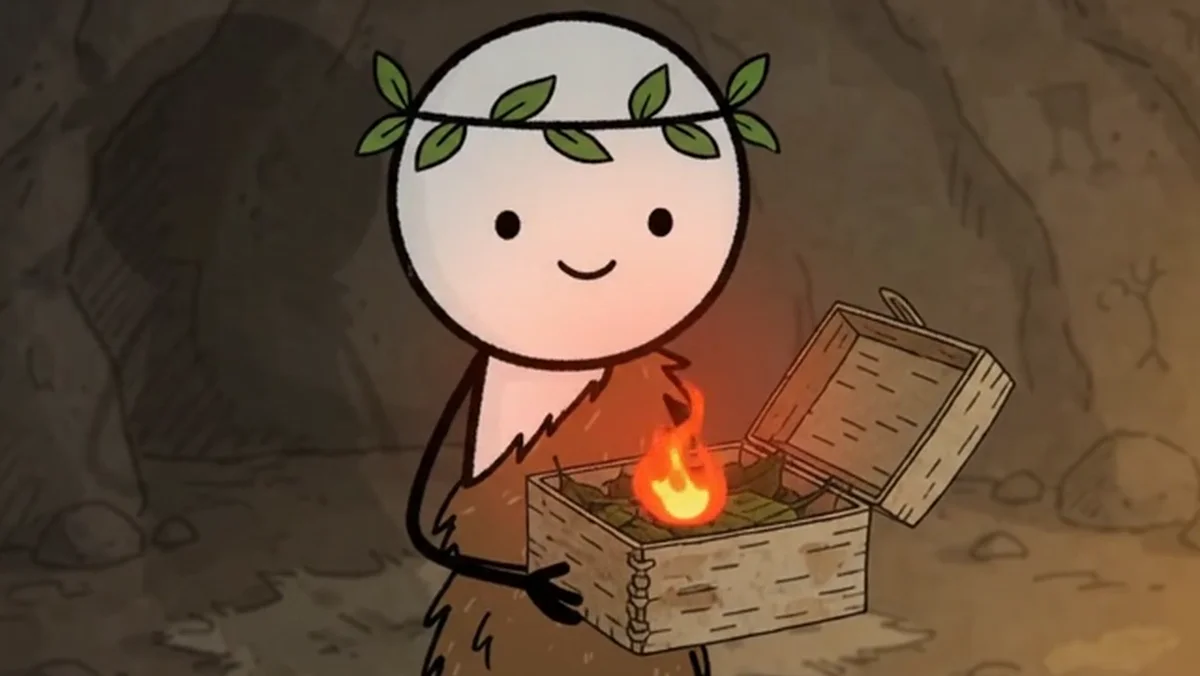
Stickman history videos are everywhere on YouTube: one small hand-drawn character, a calm narrator, a question answered in under a minute. This is how Claude Code made one in Google Flow from a single command, through the AutoFlow Chrome extension: the story, the narrator, the character, all seven scenes and the final edit. Nothing below was done by hand in Flow.
The finished video
"Tuk and the Last Ember", 55 seconds at 720p. Tuk's job is to keep his tribe's fire alive. When the tribe moves, he carries a glowing ember in a birch-bark box, a storm puts out the fire at the new camp, and his ember starts it again. The answer at the end is real: that is how people carried fire before matches.
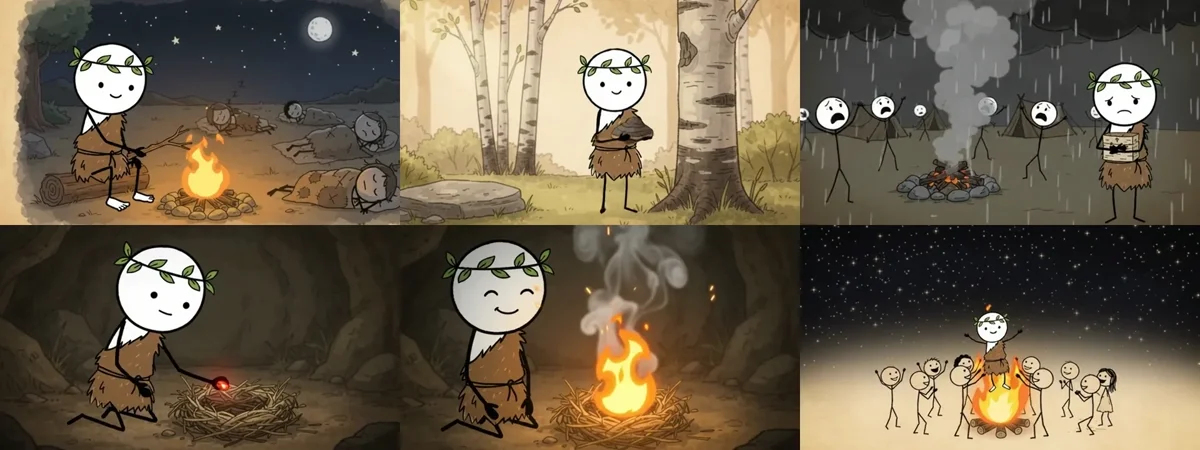
Six of the seven scenes, the same Tuk in every one.
The one command
Everything started from this, pasted into Claude Code with AutoFlow connected:
Make a stickman history video with AutoFlow.
Topic: How did ancient people keep fire alive?
Scenes: 7.
Write a real story: one small stickman character, a problem, something that goes wrong, and a clear answer at the end.
Every narration line must describe exactly what its scene shows.
Pick one narrator voice from Flow's voice list, make the stickman character once, and queue the 7 scenes in Agent mode (Omni 1.2 Flash, 16:9, 360p).
Check the facts, show me the prompts and the cost, and wait for my yes. Then run it, download the clips and edit them into one video.
Two rules do most of the work. "A real story" gives the video a problem and a turn instead of a list of facts. "Every narration line must describe exactly what its scene shows" stops the most common problem in AI stickman videos: the same line, or the wrong line, playing over every scene.
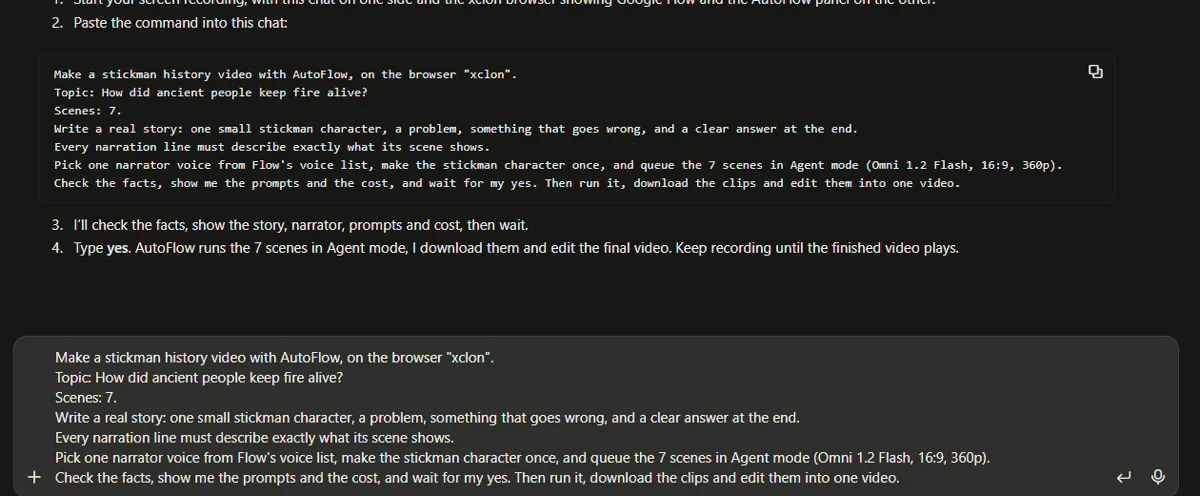
The command, pasted into Claude Code.
Step 1: facts and story
Before writing a word of story, Claude checked the history. Ötzi the Iceman, about 5,300 years ago, carried glowing embers wrapped in fresh maple leaves inside a birch-bark container. Neolithic people dried tinder fungus to catch sparks and carry fire between camps. Both facts went into the story.
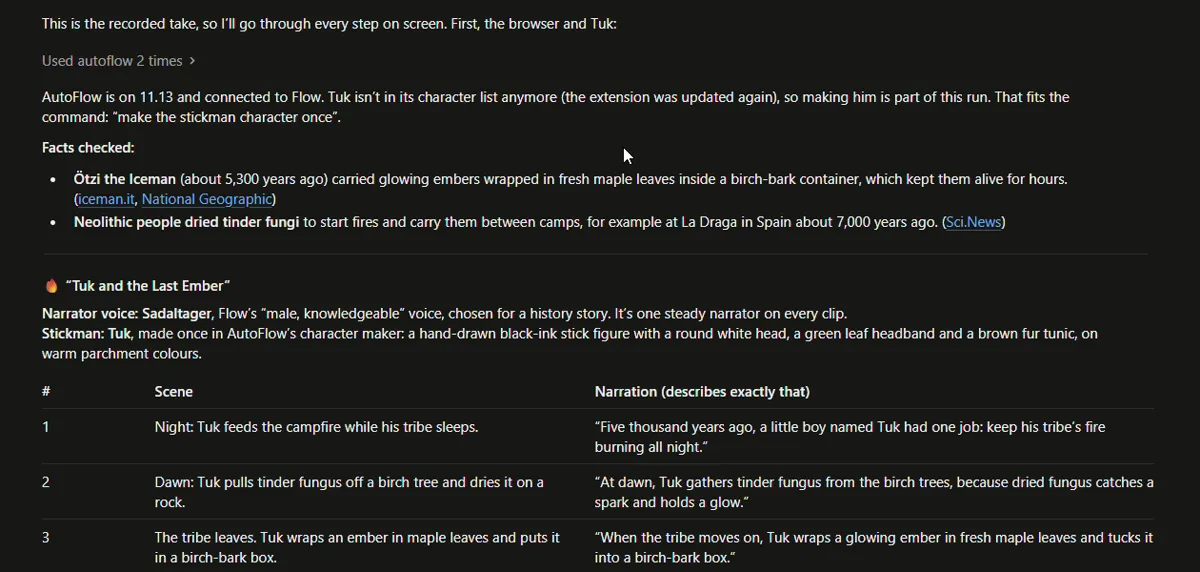
The facts, with their sources, before the story.
Then it wrote "Tuk and the Last Ember" scene by scene, with the picture on one side and the exact narration line on the other, chose the narrator voice Sadaltager (Flow's "male, knowledgeable" voice), and listed the cost: one portrait image for the character and seven video generations. Then it stopped and waited for a yes.
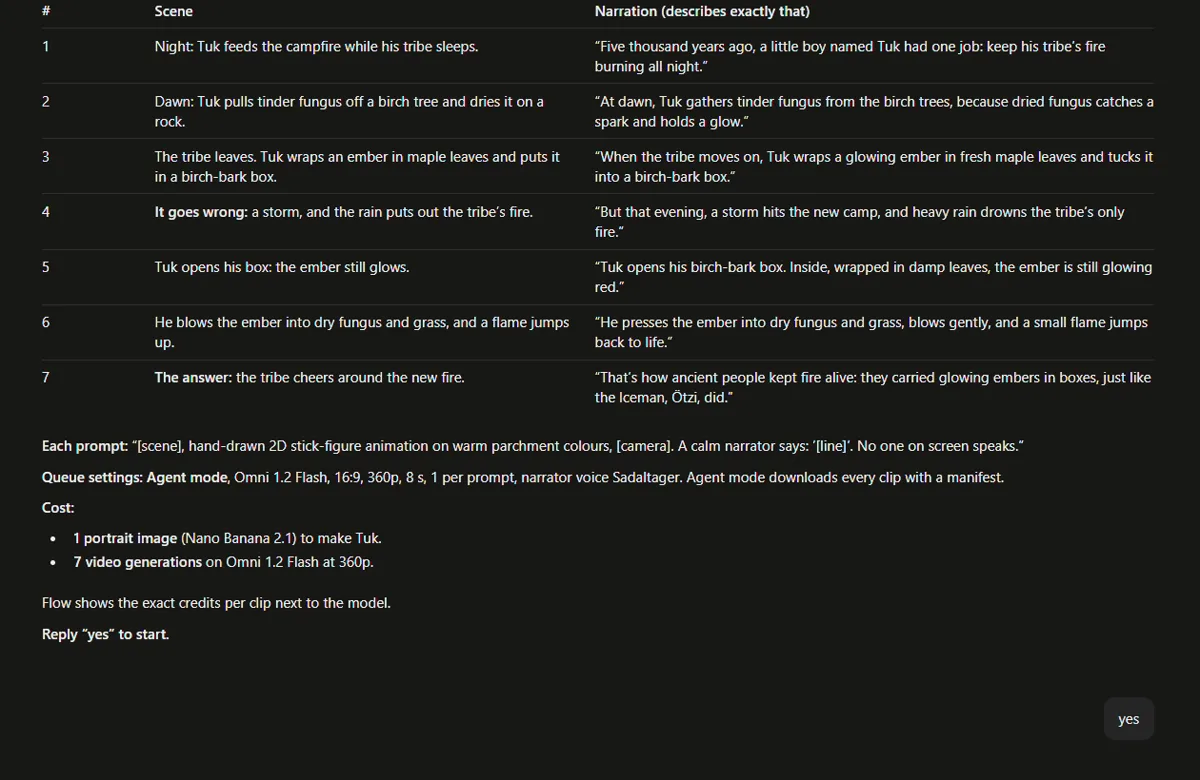
Seven scenes, seven lines, the cost, then a yes.
Step 2: the stickman, made once
Claude made Tuk in AutoFlow's character maker: a black-ink stickman with a round white head, a leaf headband and a brown fur tunic. Flow drew his portrait, AutoFlow named him and gave him a voice, and he was saved in the "AutoFlow Characters" project, so every scene can borrow the same face.
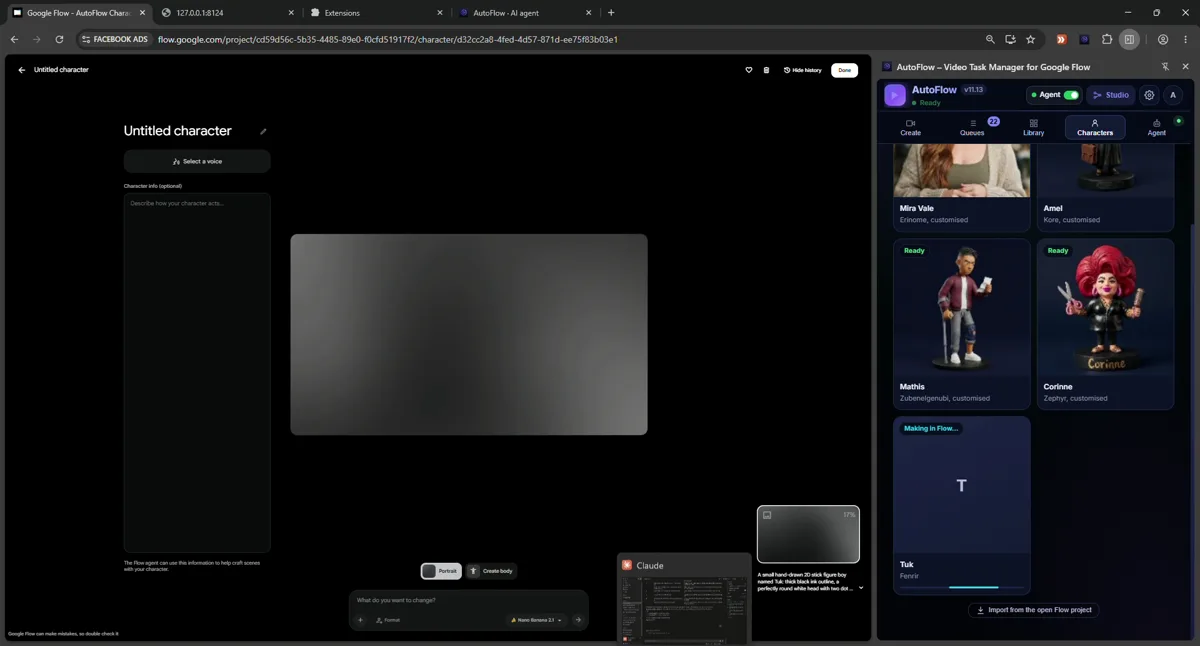
Tuk being made in Flow.
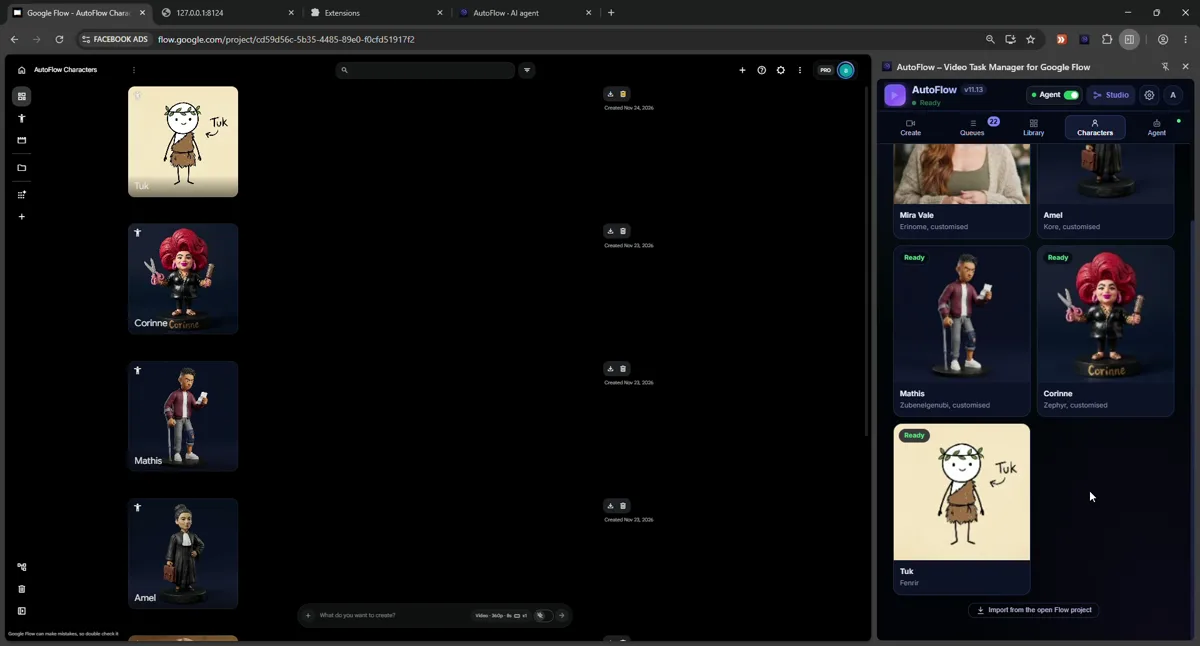
Tuk saved, ready for every scene.
Step 3: seven scenes in Agent mode
Claude added the seven prompts as one queue in Agent mode (Omni 1.2 Flash, 16:9, 360p, 8 seconds), with Tuk and the narrator voice on every prompt. AutoFlow opened a fresh Flow project, typed each scene, attached the character and the voice, and started it. Agent mode reports every event back to Claude, so it always knows which scene is generating, which is done and which failed.
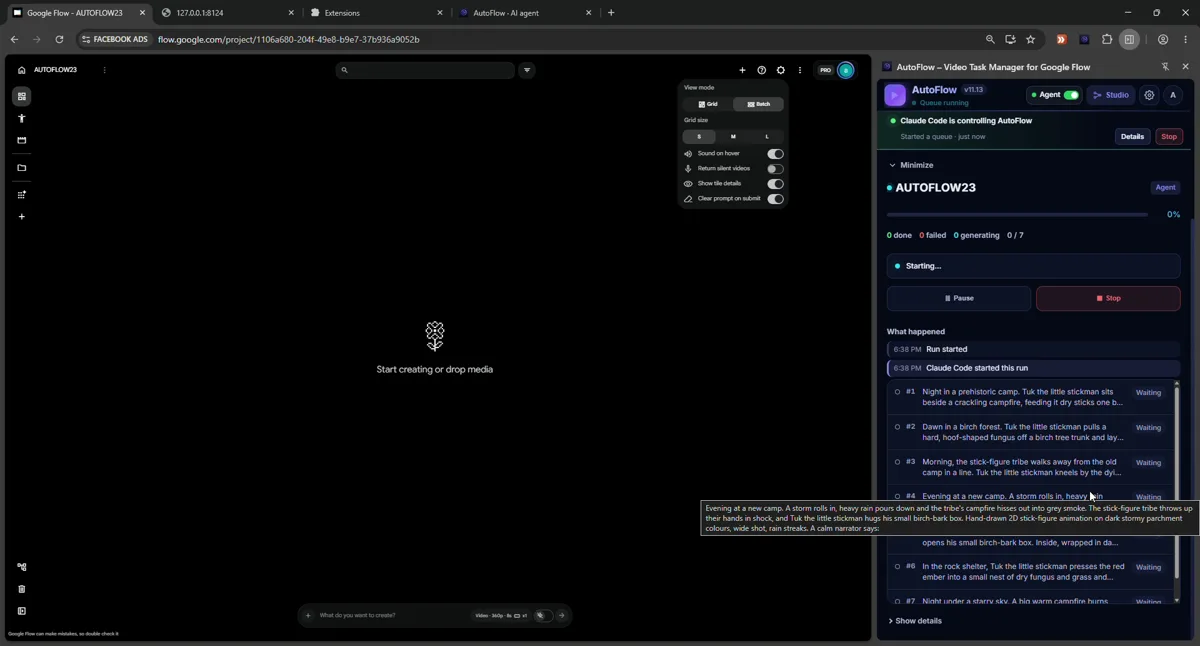
The queue starts; the agent bar says Claude is in control.
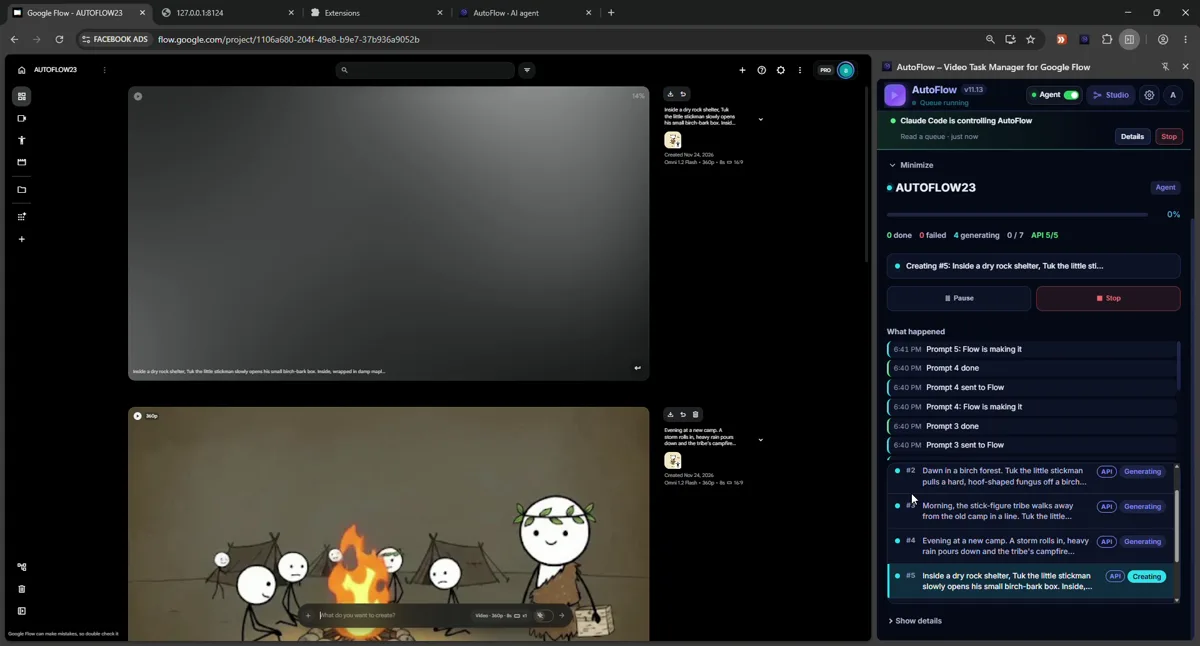
Scenes generating in Flow, the same Tuk in each.
All seven scenes were done in about four minutes.
Step 4: checking the clips
AutoFlow marked every clip done about ten seconds after it started, which looked too fast. Instead of trusting it, Claude checked the download folder: seven real files of about 2 MB each, numbered in story order, with a manifest listing every clip's prompt and file.
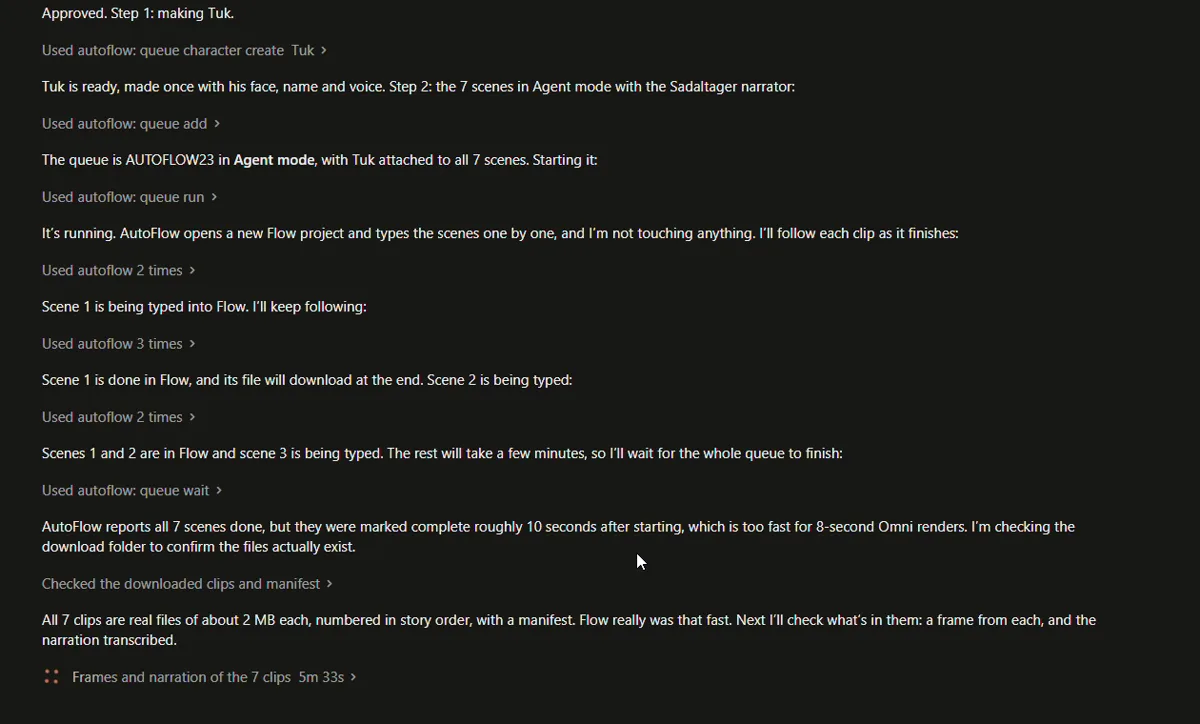
Too fast? Claude checks the files.
Then it looked at a frame from every scene and transcribed every narration line with Whisper. Each line was spoken once, in order, over its own picture, and every line ended before its clip did, so nothing would be cut.
Step 5: the edit
Claude joined the seven clips with short fades and upscaled the video to 720p. From the yes to the finished video took under ten minutes, and at the end it summed up the story, the narrator, the character, the clips and where the video was saved.
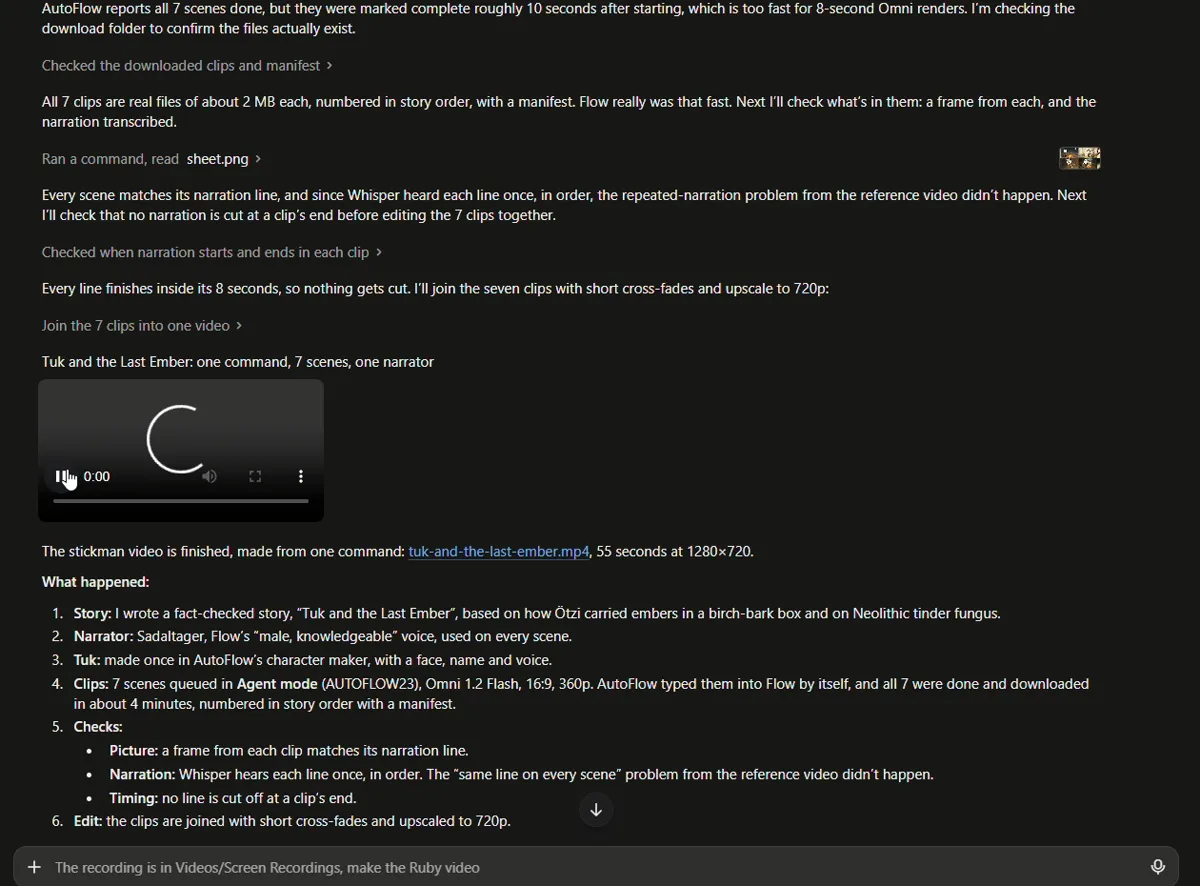
The summary, with the video ready to play.
The recipe
- Ask a question as the topic and give the number of scenes.
- Ask for a real story: a character, a problem, a turn and an answer.
- Put each scene's exact narration line in its prompt.
- Make the character once, pick one narrator voice.
- Queue in Agent mode, check the clips, then join them.
Change the topic and run it again: how did people find water, how were the first boats built, why did farmers stop moving? It works with Claude Code, Codex or Antigravity. Install AutoFlow, switch on AI agents in Settings, and see how to connect an agent.
❓ Frequently Asked
Can Claude Code make stickman animations in Google Flow?
Yes, through AutoFlow. Claude Code connects to the AutoFlow Chrome extension with the autoflow-agent MCP server. From one command it wrote the story, made the stickman character, queued all seven scenes in Google Flow, checked the clips and joined them into one video. Nobody clicked anything in Flow.
How do I stop the narrator repeating the same line in every scene?
Put the exact narration line for each scene inside that scene's prompt, and describe what the picture shows in the same prompt. In this run every prompt carried its own line, and a Whisper transcript of the finished clips confirmed each line was spoken once, in order.
How do I keep the same stickman in every clip?
Make the character once in AutoFlow's character maker with a face, a name and a voice, then write its exact name in every prompt. AutoFlow attaches the saved character to each clip, so Tuk looks the same in all seven scenes.
How much did the video cost?
One portrait image (Nano Banana 2.1) to make the stickman, and seven video generations on Omni 1.2 Flash at 360p, 16:9, 8 seconds each, on your own Google Flow credits. Claude showed the cost and waited for a yes before generating anything.
How long did it take?
Flow generated all seven scenes in about four minutes. From the yes to the finished, joined video took under ten minutes, including the checks.
Is the history in the video real?
Yes. Ötzi the Iceman, who lived about 5,300 years ago, carried glowing embers wrapped in fresh maple leaves inside a birch-bark container, and Neolithic people used dried tinder fungus to catch sparks. Claude checked both against the South Tyrol Museum of Archaeology and other sources before writing the story.
Tuk is a fictional character. The facts in the story were checked on 24 November 2026.